
Article · November 2026
Unitree Robots at University: From Demonstrations to Teaching and Research
How to turn an open-day exhibit into a platform for practical classes, experiments and final-year projects.
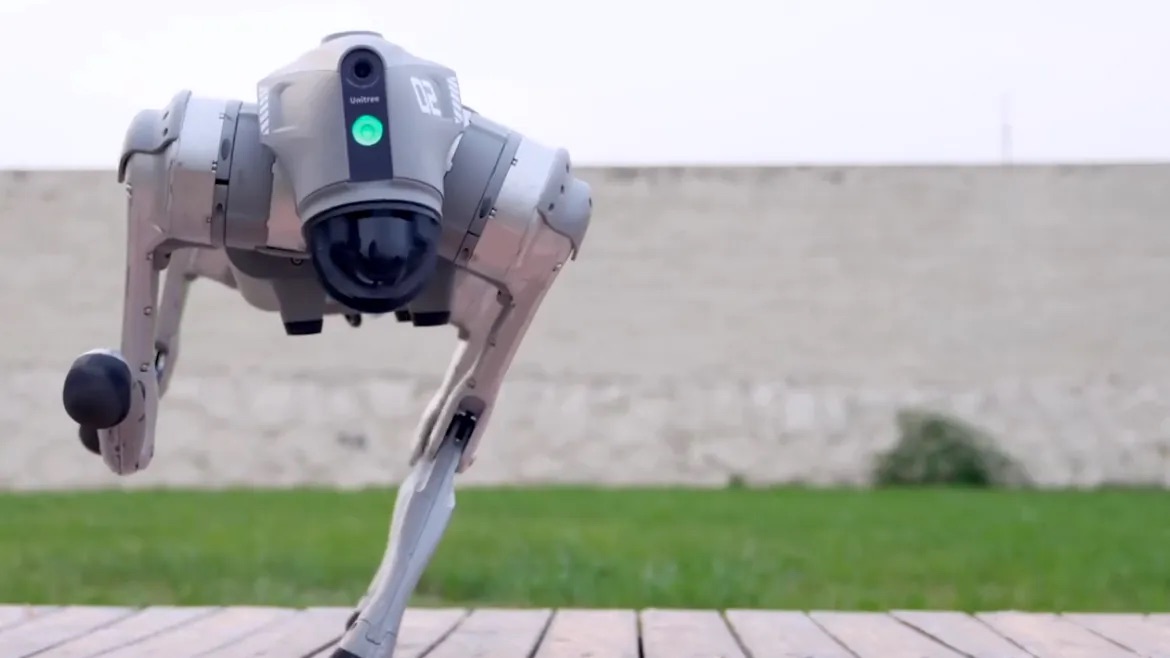
At an open day a Unitree robot gathers an audience around itself. It moves, responds to commands and gives prospective applicants a reason to stop at the stand. After the event the university faces the next task: building the platform into teaching and research.
For this it is useful to answer specific questions before buying. Which disciplines will use the robot? What will students be able to program? What data will they get? What experiment is the department ready to run in the first semester?
The platform’s educational value appears in tasks where students make technical decisions, measure the result and can reproduce the experiment. A demonstration helps to spark interest; the content of the course determines how that interest turns into competencies.
Choose the research task first, then the model
The wording “a robot for artificial intelligence” leaves too much uncertainty. To choose a configuration the direction of work must be specified.
| Direction | Possible task | What must be confirmed before purchase |
|---|---|---|
| Mobile robotics | Comparing ways of following a given route | The control interface, available data, position estimation tools and test conditions |
| Computer Vision | Determining an object’s position in a controlled scene | Access to the camera stream, sensor specifications and computing resources |
| Motion control | Studying an algorithm in simulation followed by testing on the platform | The supported level of control, the robot model, limitations and conditions for admission to tests |
| Manipulation | Moving a given object in the work area | Availability of suitable arms or a manipulator, a gripper and software access |
These are possible directions for university projects. Their feasibility depends on the specific model, the configuration and the amount of in-house development. A sensor in the specification does not yet mean the required data is available through the required interface.
For a navigation task in a flat room it is also useful to consider a wheeled platform. A quadruped or humanoid design gets a clear justification when its features are part of what is being taught or researched: movement over difficult surfaces, balance, limb kinematics or interaction with objects.
Understand the configuration and development access
Devices with similar names can offer different capabilities. On the official Unitree G1 page independent development is indicated for G1 EDU; for the base G1 this capability is not declared. The manufacturer also marks optional components separately there and warns that some of the demonstrated functions are still in development. Unitree Robotics
So a demo video should be supplemented with a technical check. Ask to be shown, on the offered configuration, the reading of the required data, running an example from the documentation and executing the required command.
The supply specification should record the model and version, the sensors, the compute modules, the software interfaces, the documentation and the terms of technical support.
For a faculty the answer to a practical question is important: will an instructor be able to reproduce this launch after the equipment is handed over?
Build the practical course from data to control
The first sessions can be devoted to the system’s structure and recording the available states. Students study message formats, timestamps, units of measurement and ways of saving data. Even here a full teaching task is possible: obtain a recording, visualise the signal and explain its behaviour.
Then limited experiments are added through the supported interfaces. It is important to distinguish control of ready-made motion functions from low-level actuator control: they require different preparation, test organisation and code review.
Unitree publishes development tools, including SDK2 and ROS 2 packages. The official ROS 2 repository contains examples of reading states and controlling certain models. The contents of these examples must be checked against the chosen robot and the software versions. unitreerobotics/unitree_ros2 · GitHub
A good result of a practical course includes code, a description of conditions, the original recordings and conclusions. The next group should understand how to repeat the work and what to compare its own solution with.
Use simulation to prepare the experiment
In simulation it is convenient to check logic, reproduce identical initial conditions and compare algorithm variants before moving to the physical platform.
The official unitree_mujoco project is intended for working with Unitree tools in the MuJoCo environment. Its documentation states that the current version is oriented towards low-level development and testing controllers when moving from simulation to the robot. This does not mean any applied scenario is supported without further work. unitreerobotics/unitree_mujoco · GitHub
For a teaching course the transfer can be set up as a separate investigation: compare the result of the model and the physical device, identify discrepancies, propose explanations and test some of them. Delays, contact with the surface, measurement errors and the conditions of the experiment may prove significant.
A successful launch in simulation serves as a stage of verification. Admission to a physical test requires a separate assessment by the instructor and compliance with the manufacturer’s instructions.
Frame a thesis project as a comparison
The topic “Creating a smart robot” hardly sets any limits to the work. The topic “Comparing two ways of route correction on a given track” makes it possible to define the experiment and the result criteria.
For example, a department can propose the following teaching scenario: a team implements two variants of an algorithm on a compatible platform, fixes the route and conditions in advance, then compares the completion time, the deviation from the trajectory and the number of operator interventions.
The number of tests is chosen to suit the task; all failed runs are counted according to rules set in advance. It is desirable to estimate the robot’s position by an independent method of known accuracy so as not to mistake an error in one’s own estimate for confirmation of the algorithm’s quality.
This is an example of how a study can be framed, not a ready-made Unitree function. The navigation algorithm, position estimation and data processing may require additional equipment and development.
At the defence the student must explain the original method, their own change, the way of measurement and the limits of the conclusion obtained. Even a negative result is meaningful if the experiment was conducted correctly and makes it possible to understand the cause of the limitation.
Organise the laboratory’s work
The platform should have a responsible instructor and a staff member who maintains the working configuration. For several departments you need an access schedule, change tracking and a verified baseline configuration to which you can return.
Space for testing, maintenance, team training and the procedure for admitting students are planned separately. Controlling a powerful physical system requires a prepared place, an operator and an agreed way of stopping safely. Test parameters are determined by the documentation of the specific model and the laboratory’s risk assessment.
For the first semester it is sensible to choose a limited set of results: a few prepared lab works, a saved dataset, a reproducible experiment and instructors able to run the sessions. Their scope should be agreed with the team before purchase.
The most useful question when choosing Unitree for a university: what work will students and researchers be able to do on this configuration already in the coming semester? The answer ties together the technical specifications, the department’s preparation and the actual workload of the equipment.