
Robotics · 9 November 2026
Why one robot follows a route precisely while another keeps making mistakes
The same program does not mean the same trajectory. We look at how mechanics and code together control a robot's motion.
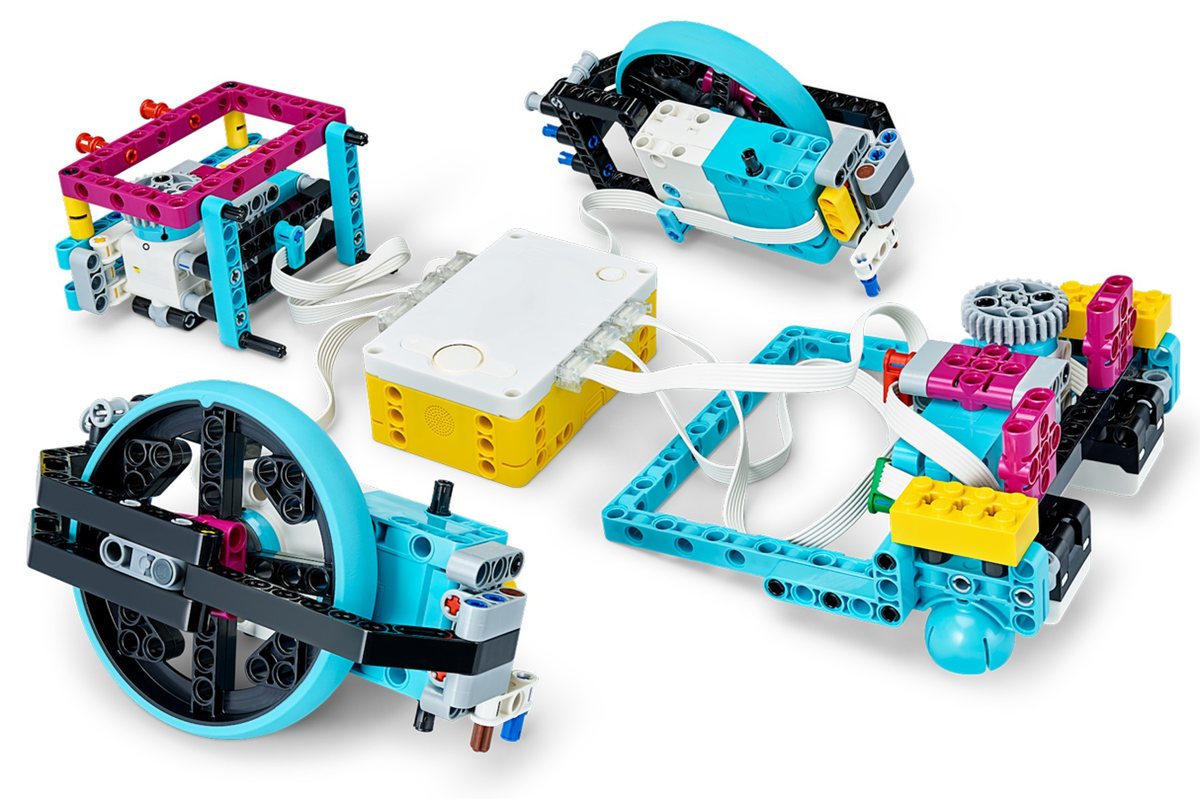
Two robots get the same command: drive forward and turn towards the finish. The first stops almost at the right point. The second ends up slightly to the left. After the next turn the difference becomes even more noticeable. Although the models look alike, their movement is influenced by a whole chain of causes: from the position of an axle to the moment the program issues the stop command.
For educational robotics lessons this is a meaningful engineering task. On one route you can see the link between construction, mathematics and programming. It is especially interesting to watch how a small change in the model changes the result of the entire run.
What happens between a command and movement
The program gives the motor an action. The motor turns an axle, the axle transmits motion to a wheel and the wheel interacts with the surface. Each link in this chain affects where the robot ends up.
For example, the same number of rotations of wheels of different diameters gives different distances. A larger wheel covers a longer distance in one full turn if it rolls without slipping. This is how the familiar circumference formula becomes a way to explain real movement.
Students can be asked to first calculate the distance and then measure it on the field. The difference between the calculation and the run gives material for discussion: how accurately the diameter was measured, whether the wheel slips, whether the launch conditions are the same.
Why construction affects the route
For straight-line movement the symmetry of the running gear matters. The wheels must turn freely, the axles must not visibly bend and parts of the body must not touch the surface. Even a carefully written program works through a physical construction.
A separate subject of investigation is the position of the load. If you add a gripper to the robot or move a heavy part, the mass distribution changes. This can affect the grip of the drive wheels and behaviour during acceleration. A student can test their own hypothesis: what changes if the same load is moved closer to the drive axle?
LEGO Education teaching models are convenient for such comparisons: the construction can be taken apart, rebuilt and tested again. It helps to keep photographs of the variants so that specific changes can be discussed.
Speed also takes part in the solution
A fast run looks impressive, but for a small field controllability matters. With sharp acceleration and braking the contact conditions between the wheels and the surface may change. If the task requires an accurate stop, it is interesting to compare movement at constant speed with movement that slows down before the target.
This becomes a task with two criteria: time and accuracy. One team may offer a faster variant, another a more repeatable one. It is easier to discuss their solutions based on the results of several runs, because one successful run says little about the behaviour of the system.
How a sensor helps a robot refine its movement
This is where the concept of feedback appears. In the simplest case the robot executes a given sequence of commands. When sensors are used the program receives information about what is happening and can adjust the action.
Depending on the model’s equipment these may be readings of motor rotation, body orientation, distance to an obstacle or position relative to a line. A rotation sensor reports the movement of the mechanism but does not by itself prove that the wheel travelled the same distance on the floor: possible slipping remains a separate factor.
For a student this is an important step in understanding robot programming. The command “turn” becomes the task “turn, watch the change and stop when the required condition is met”.
One route as an engineering investigation
For a small project it is enough to mark the start, a straight section, a turn and a finish area. First the team tests the original model and then chooses one change: the position of the load, the speed or the way the turn is detected. The other conditions are kept as identical as possible.
The results can be shown on a plan of the field: mark the stopping points and compare how widely they are scattered. This work combines measurement, geometry and analysis of the program. The project gets a meaningful story: what assumption the team had, what it changed and what it saw after testing.
In a robotics classroom this requires models, a surface for runs, a place for assembly and the ability to record observations. It is the combination of these elements that turns a short robot trip into a full engineering task.
Kerneu Group offers equipment and furniture for classrooms. See the solutions for educational institutions, including the equipment of robotics classrooms in Kazakhstan.