
LEGO Education · 9 November 2026
Why a bridge holds a load: engineering with LEGO Education models
One diagonal part can change the behaviour of an entire structure. We explore how shape, supports and joints help a model carry a load.
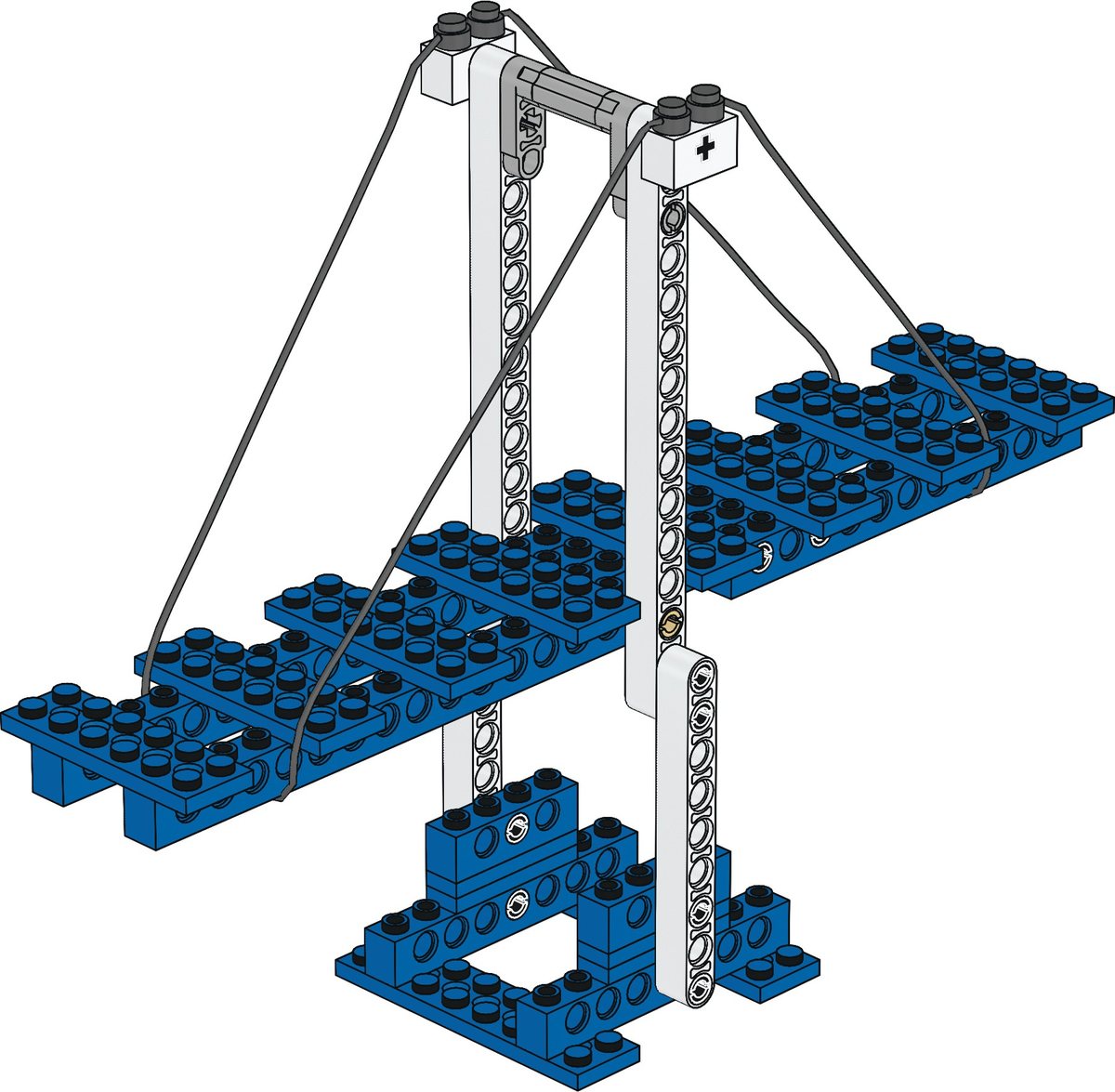
Two teams build bridges from a similar number of parts. One sags noticeably under a small load. The other keeps its shape. The difference may be explained by how the elements are arranged, where the supports are and how force is transmitted.
LEGO Education models in lessons let you look at these questions on a construction you can hold and rebuild. The concepts of stability, stiffness and load take concrete form: students see what happens to their own model.
Why the number of parts does not explain everything
The intuitive solution often goes like this: to make a bridge stronger, add more parts. Sometimes this helps, but the way they are placed matters too.
If you join elements into a frame with movable corners, it can easily change shape. Adding a diagonal brace restricts this movement. This example is convenient for discussing why triangular elements and diagonal braces appear in engineering structures.
A student can compare the frame before and after the change. The question becomes sharper: which part changed the behaviour and why? This links construction with explaining an observed effect.
Stability and stiffness mean different things
A model may keep its shape but tip over because of an unfortunate support position. Or it may stand stably but bend noticeably under load. In everyday speech both situations are sometimes described as “weak”, although the engineering causes differ.
Stiffness is related to resistance to deformation. Positional stability helps to discuss whether a structure will stay in equilibrium under a chosen action. Strength refers to the ability to withstand load without breaking.
For a first introduction it is enough to show the difference on a few small models. Students can then use the new words when describing their own bridge, tower or lifting mechanism.
Why the point of load application matters
Imagine a beam resting on two ends. If the same small weight is moved, the conditions of its work change. A load near a support and a load at mid-span can produce different deflection.
Such an experiment helps to see why a designer considers not only the mass of an object but also its position. For a school model you can mark several points and compare observations. The load is chosen to be small so that the structure’s behaviour can be examined without sudden failure.
It is useful to agree beforehand what exactly is being compared: visible deflection, positional stability or the ability to hold a given weight. Then the discussion relies on the same criterion.
How to make a test meaningful
The models must have comparable conditions: the same span between supports, the same way of placing the load and the same surface. If everything is changed at once, it is hard to understand the cause of the result.
Teams can be given a limit on size or on the number of certain elements. That leaves room for different solutions: strengthening the joints, changing the height of the side, adding diagonals or redistributing parts.
Each team explains its choice before the test. Afterwards students compare the prediction with the behaviour of the model. Even a simple bridge becomes a reason to discuss a design decision through observation.
Where this mechanics appears outside the classroom
After working with a model, familiar structures begin to look different. Students notice the bracing in building trusses, the supports of sports equipment and the reinforcement of frames. They can look for similar principles and explain what role the arrangement of elements plays.
At the same time a model remains a simplification. It helps to investigate a single principle, while real structures require calculations of materials, joints and many operating conditions. This distinction is useful for understanding how engineers work with models.
Construction combines geometry, physics and a practical solution to a task. A student gets the opportunity not only to assemble an object but also to explain why the chosen shape behaves in a certain way.
In the Kerneu Group catalogues present educational solutions, and the section classroom equipment lets you explore the directions for schools in Kazakhstan.