
Robots and research · 9 November 2026
How a robot keeps its balance and why an ordinary step is so hard
Behind a single step of a humanoid lies the coordinated work of joints, measurements and algorithms. We look at this task from an engineering point of view.
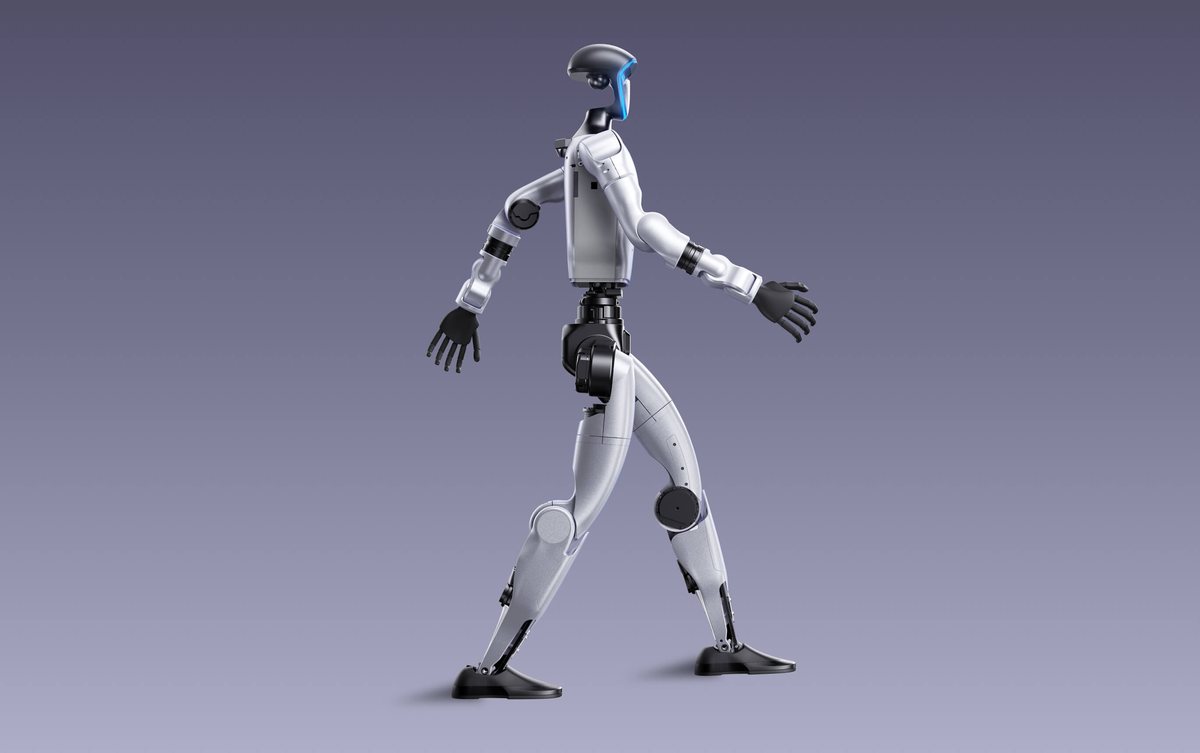
The robot lifts one leg, moves it forward and keeps going. For an observer it is a short episode. For the control system it is a change of support, of link positions and of interaction with the surface. Even an ordinary step combines many linked actions.
That is why a humanoid robot for a university is interesting as an object for studying mechanics, automatic control and computational methods. Through motion you can look at problems that would otherwise remain a set of separate formulas and models.
Why standing and walking are different tasks
When the robot rests on both feet, the support area differs from the case when one foot is raised. Along with the link positions, the mass distribution and the balance conditions change.
For slow, near-static positions a simplified model is useful: the projection of the centre of mass must lie inside the support area. It helps explain why shifting the torso is linked to preparing a step.
In dynamic motion one such condition is not enough. Velocities, accelerations and contact forces matter. That is exactly why a walking algorithm cannot be reduced to replaying several nice poses in sequence.
What coordinated joint motion means
A robot’s leg is a system of links and joints. Changing the angle in one joint affects the position of other parts of the structure relative to the surface and the body.
To move the foot to the required point several movements have to be coordinated. To keep the body position, even more constraints must be taken into account. This introduces students to kinematics: the description of the position and motion of a mechanism.
The next level is dynamics. Here the masses of the links, accelerations and the required actuator forces are added to the geometry. The same trajectory executed at a different pace can place different demands on the system.
Why feedback is needed
Real motion differs from the ideal calculation. The surface, the state of contact and other factors affect the platform’s behaviour. The control system uses measurements to estimate the state and refine commands.
Depending on the design, data on joint positions, body motion and other signals are used. Inertial measurements help to describe rotation and acceleration, and actuator sensors provide information about how the links are working.
This creates a closed loop: a command causes motion, measurements describe the state, and the controller calculates the next action. For a student it is a clear link between control theory and a physical device.
Where Unitree G1 fits into this task
Unitree G1 is a family of humanoid platforms. The manufacturer’s table lists G1 and G1 EDU separately. The possibility of secondary development is indicated for EDU, so a research scenario is tied to a specific version and the available interfaces.
To understand the task it helps to separate the platform’s ready-made motion from the student team’s own algorithm. Observing motion, analysing supplied data and developing a controller are different levels of working with a robot.
This makes it possible to choose a meaningful topic for a specific course. At one level students study a kinematic model, at another they process recordings, at the next they work with algorithms in a prepared environment.
Why research often starts in simulation
In a simulator you can set up a robot model and look at its behaviour under chosen conditions. This makes it possible to study parameters and compare approaches before a physical test.
Unitree publishes the unitree_mujoco project for simulation using the tools of its own software environment. Having a model does not remove the differences between the computed environment and the real robot: contact, delays and mechanical properties may be reproduced with limited accuracy.
For teaching, this difference is itself of interest. Students can explain what assumptions are built into the model and which results need separate verification. Physical tests are carried out following the manufacturer’s instructions, in a prepared area and under the supervision of specialists.
What topics a single step brings together
In a robotics laboratory you can link linear algebra, programming, mechanics and control. One project looks at the foot position, another at changes in the body state, a third at visualising motion data.
Such work has a concrete engineering object and observable behaviour. This helps to discuss not only the chosen method but also its assumptions, limitations and scope.
Take a look at the Kerneu Group robots for universities and research laboratories and equipment catalogues.